

Elastomeric Bearings
Elastomeric bearing
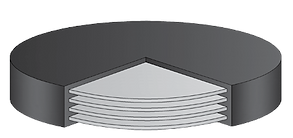
an elastomeric rubber block laminated with reinforcingsteel plates that are vulcanized when built to provide a high permissibility of heavy loads
As an elasticproduct, Elastomeric bearing allows :
1. Vertical compression deformetion
2. Shear deformation to satisfy horizontal deformation
3. Rotational deformation as shwon in figures It also has perfect antivibrationfor reducing impact & dynamic load effect.


Vertical Compressive Load

Horizontal Displacement

Rotational Deformation
As a durable, reliable, light, small & easy to maintained product, the elastomeric bearings became a perfect solution for the designers in many construction applications.
Types of Bearings & Usage


Type A
Laminated bearings with only one steel reinforcing plate
Type B
Laminated bearings fully covered with elastomer with at least two steel reinforcing plates
Type C - C2
Laminated bearings with outer steel plates that allows fixing with external anchoring system, which is offered by

Used especially for steel beams with occasional, temporary and irregular traction forces.
Type C - C4
Laminated bearings with outer checkered steel plates to allow high friction with the construction They are designed for both cast-in-situ concrete and precast concrete elements.
Type D
Type B with PTFE sheet bonded to elastomer
Type E
Type C with one outer plate ponded to the elastomer and PTFE sheet recessed in the steel
Type F
Plain pad bearings & strip bearings This bearing can be provides in long strip & then cut to length.
We provides all the types specified in the EN 1337-3 standard and also can provide
any additional shapes as required from our clients
Aspects and Architecture
Elastomeric bearings are produced in rectangular, square & circular shapes for all types

Elastomeric Bearing Restrained in one direction
Elastomeric Bearing Restrained in two directions
Constraining Movement
In normal conditions, elastomeric bearings allow the horizontalmovement in both plan directions X & Y.
But according to the requirement of the designer, the movement can be restrained in one direction or in both directions to allow only the vertical displacement &rotation
provides the restrained bearings in different designs according to there quirement of designer.


Elastomeric Bearing Restrained in two directions


Elastomeric Bearing Restrained in one direction

Material Specifications
The elastomeric material used is a compound from either Natural Rubber (NR) thatprovides a high performance against compressive & shear loads or Synthetic Poly Chloroprene Rubber (CR) that got a very good aging characteristics, as per the
design requirements or country regulations.
Physical Properties
provides a high performance bearings with a body of Natural Rubber (NR) & outer surface of Synthetic Chloroprene Rubber (CR), which combines theadvantages of the both materials

The Elastomeric material manufactured by complies with the requirement
of the international standards such as EN 1337-3, BS 5400, AASHTO M251-06, etc.
The following table identifies the physical properties of rubber as defined in EN 1337-3

Standard Elastomeric Bearings
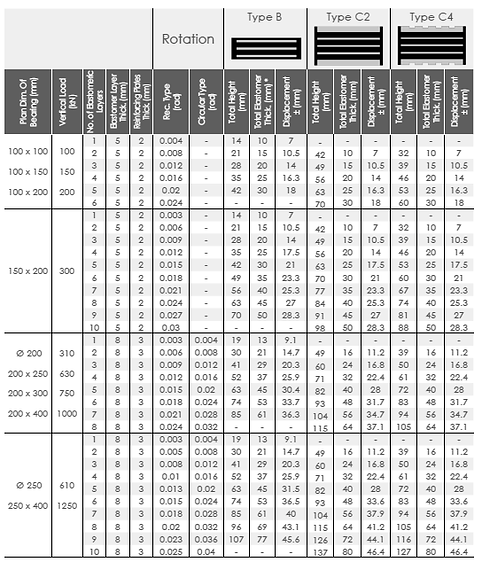
The following table is a sample for the available sizes of elastomeric bearings


Sliding Elastomeric Bearings
provides elastomeric bearingswith a vulcanized sliding layer of Teflon– PTFE.
This sliding plate allows for large displacements than the regular types of elastomeric bearings, as the displacement range depends on the dimensions of the external sliding plate. The sliding elastomeric bearings are provided in 2 types,
Type D: The sliding PTFE plate is vulcanized on the external elastomeric layer of Type B bearing.
Type E: The sliding PTFE plate is vulcanized on the outer steel plate of type C2/B bearing.The following table contains some sizes for the sliding elastomeric bearings provided by , other sizes & displacement ranges are available upon request.
Note: minimum pressure of 3 N/mm² shall be applied to ensure that the bearingwon’t move from its base.


